How to Use AI and Data to Find Well-Funded PIs
Most researchers hold 1-2 grants. The top hold 38. Here's how to find them.
How to use AI and data to find well-funded PIs
In my recent post about guerrilla strategy for academic job searching, I talked about cold-emailing well-funded PIs before they advertise positions. Today, I'll show you how to find them using AI and data.
The problem: Most funding databases are massive and unorganized. Searching manually takes forever. You need a way to identify which PIs have multiple active projects and generous funding.
The solution: Use AI to help you collect and analyze the data strategically. Here's how I did it: Step 1: Identify the right funding database -Germany: DFG GEPRIS database -EU: Horizon Europe project database -US: NIH RePORTER or NSF Award Search -UK: UKRI Gateway to Research etc. Pick the database relevant to where you want to work.
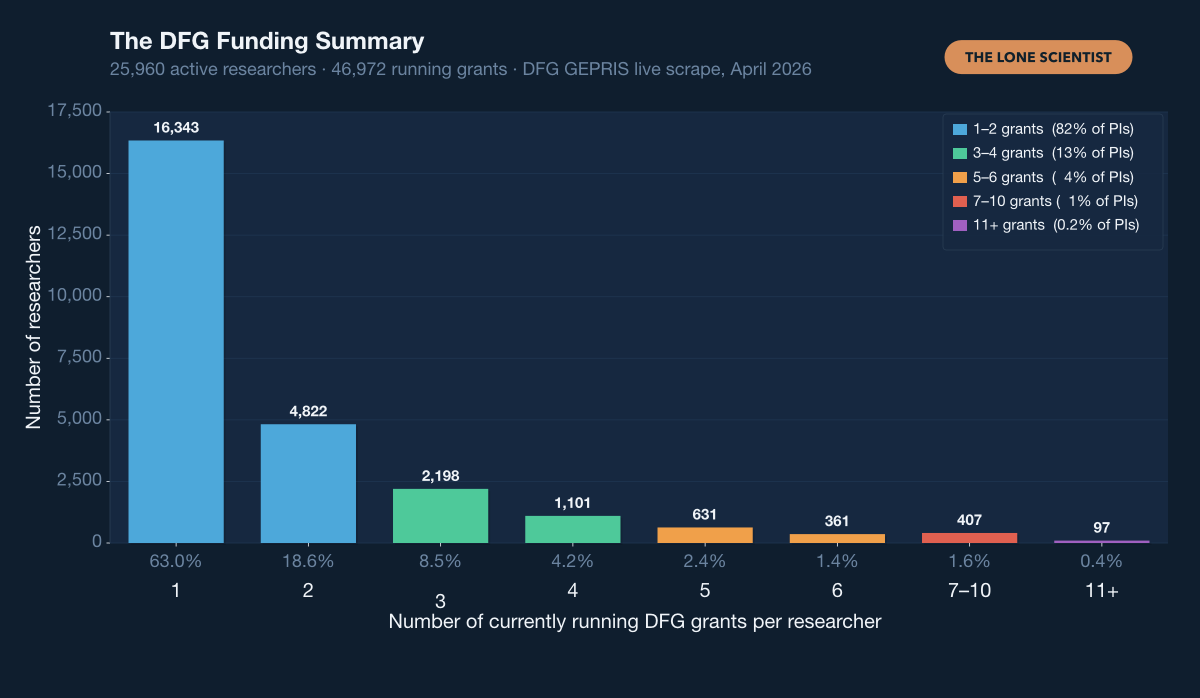
Step 2: Use AI to collect the data I used Claude, but ChatGPT or other AI tools work too. Here is an example of Germany DFG Funding. The DFG has a public database called GEPRIS—every funded project, every principal investigator, openly accessible. I first tried a Kaggle dataset someone had already compiled. It was outdated. So I went directly to the source. I asked Claude to write a Python script that visits every researcher's GEPRIS page and collects their running projects. After running it, I had a clean CSV file: 46,972 running grants across 25,960 researchers.
From there: count grants per researcher, categorize them (1 grant, 2-4 grants, 5+ grants), and calculate percentages. Then build a bar chart—dark background, color-coded by grant tier, white labels, exported as PNG and SVG. That's it.
The most important step wasn't the code. It was knowing which question to ask: "Who actually holds the money?"
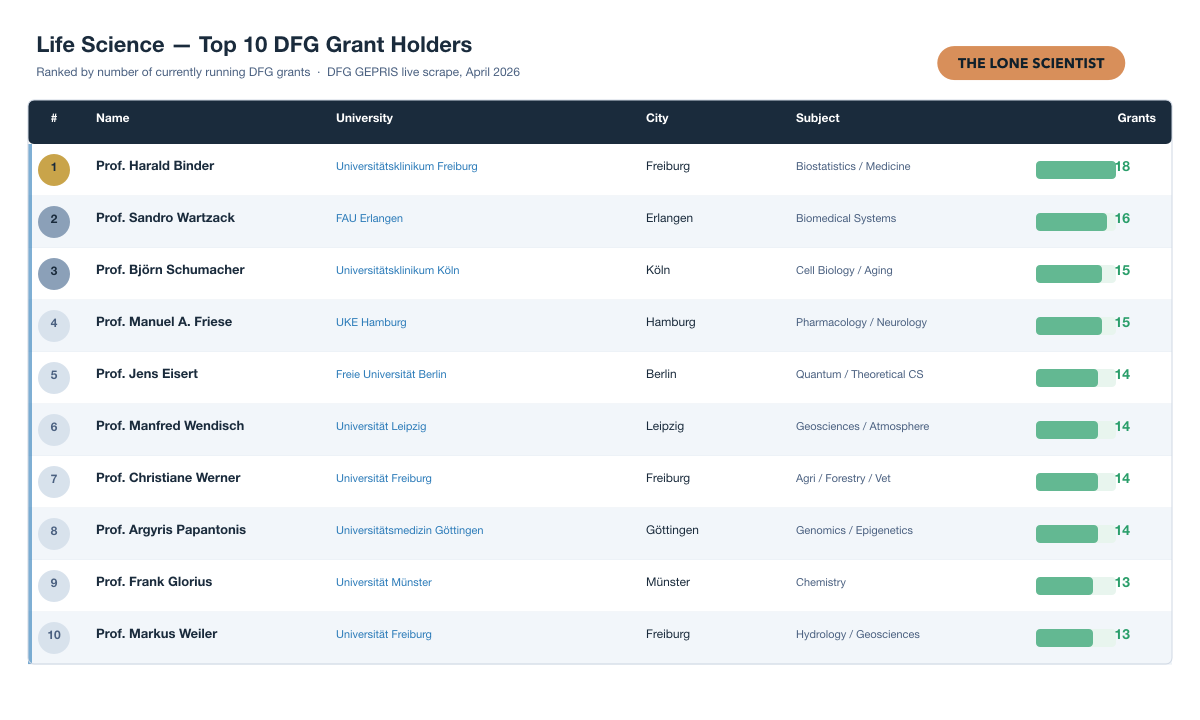
What I found: 82% of researchers have only 1 or 2 active projects. This doesn't mean they have no positions—but statistically, they have less flexibility and fewer resources. But the PIs with 5+ projects? They have the money, the resources, and the ability to create positions. These could be your targets. For example, you can see that the top 10 professors with the most grants in Life Sciences in Germany each hold 13+ active projects.
Have you tried data-driven job searching?
Newsletter
Get the next post in your inbox
New posts on DFG funding, academic careers, and research strategy — once or twice a month.